
'The path to a resolution of the ethnic conflict is likely to be complicated and controversial with the majority Sinhalese community, and will become less likely if delayed.' 'It will certainly give Rajapaksa fresh political oxygen with which to revive himself and rally the opposition.'
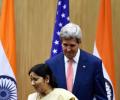
There was no breakthrough in US Secretary of State John F Kerry's India visit, but no breakdown either, says C Uday Bhaskar.

United States Secretary of State John Kerry, heading a high-powered delegation of his cabinet colleagues and top military commanders, today left for India as part of his 10-day seven nation Asia trip.

Narendra Modi's promise to allow states a bigger say in strategising and building foreign policy is unexceptionable, says TP Sreenivasan.

'India may be new to world politics and her military strength insignificant in comparison with that of the giants of our epoch.' 'But India is old in thought and experience and has travelled through trackless centuries in the adventure of life.' 'Throughout her long history she has stood for peace and every prayer that an Indian raises, ends with an invocation to peace.' Jawaharlal Nehru's memorable speech to the United States Congress.

India and the United States have reached the first commercial agreement on civilian nuclear power, five years after a landmark deal between the two countries was clinched.
'As the tanks roll down Delhi's Rajpath and the C-17s fly overhead, there could be a lot brewing in Hyderabad House,' says Surya Gangadharan.
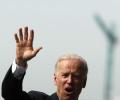
United States Vice President Joe Biden on Monday left for a rare vice presidential trip to India for the first leg of his visit to the Asia-Pacific region.
Flaring of tempers comes atop much simmering trouble on clashing views; these stands might now get frozen.
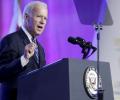
While inaugurating the leadership summit of the US-India Business Council in Washington, DC, US Vice President Joe Biden said that there was no reason why the two largest democracies in the world should not continue to have a more productive relationship. Aziz Haniffa/ Rediff.com reports.

Xi and Modi met soon after their arrival at a summit of the BRICS group of emerging powers. Xi said the two countries should join hands in setting global rules and suggested he attend the November meeting of the 21-nation APEC in Beijing, as well as take part in Chinese-led regional initiatives.

North Korea is unlikely to strike first, but its response in retaliation, if attacked, could be massive even at the expense of its own destruction, says Rajaram Panda.

The Indo-US defence relationship may now get personal attention with strong India-backer Ashton Carter today being nominated by President Barack Obama for the key post of the defence secretary.

Modi presented Obama with a richly silk-covered special edition of Mahatma Gandhi's interpretation of the Bhagvad Gita, and recordings of Dr Martin Luther King's speech when he visited India in 1959 and also a specially framed photograph of Dr King when he visited Rajghat. Modi had scrupulously researched and selected these gifts for Obama and more gifts would be presented on Tuesday during their summit for both the President and the First Family.

Indian Ambassador to the United States Dr S Jaishankar told Rediff.com's Aziz Haniffa that it was "a very nice meeting and President Barack Obama was extremely cordial."

Special 301 Report expresses concern over weak IPR laws, to conduct reviews.

Indians in countries like the United States, China, Australia, Japan, Singapore, Egypt, Israel and South Africa celebrated the day with hoisting of the national flag and singing of patriotic songs.

The government must justify why we need to buy foreign reactors when we have developed up to 700 MWe unit-size pressurised heavy water reactors, a design which can be easily extended to 900 to 1000 MWe unit size. Why can't the 'Make in India' philosophy apply to indigenous nuclear reactors, more than 18 of which have been designed, built, and being operated by Indian engineers, asks Dr A Gopalakrishnan.

Civil Aviation Minister Ajit Singh has said that India is a land of emerging opportunities and the aviation scenario in the country is fast changing and poised for breaking boundaries and scaling new heights.

'Xi Jinping got a dose of Modi's medicine inside the tent where he was being hosted on the banks of the Sabarmati river.' 'Modi reportedly told him, looking deep into his eyes: "This was not expected of your country. Can you tell me when the troops are withdrawing?".'

The target of $500 billion in bilateral trade by 2020 is doable, feels Anand Sharma.


'We have a common way of looking at the world, a common way of thinking, and a common set of values that predispose us to be partners. And our interests overlap greatly,' Dr Ashton B Carter, America's next defence secretary, told Aziz Haniffa/Rediff.com in an exclusive interview.

Moving ahead with their new mantra -- Chalein Saath Saath: Forward Together We Go -- Prime Minister Narendra Modi and United States President Barack Obama on Tuesday vowed to deepen cooperation in every sector for the benefit of global stability and people's livelihoods over the next ten years.

India must present its demands of America confidently, instead of fearing that its pocket will somehow be picked, says Ajai Shukla.

'Those who have seen the functioning of the Modi government in Gujarat know that the issues related to Hindutva and issues of economy and growth function simultaneously.' 'Modi's politics are based on the understanding of the middle-class consumer society which is in pursuit of material aspirations.' Sheela Bhatt/Rediff.com reveals the Modi government's economic and political plans for the year ahead.
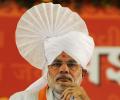
The second and final part of former cabinet secretary Naresh Chandra's interview to Sheela Bhatt.

'India is no longer the India of the '70s and the '80s.' 'It's a large country with the fastest growing economy.' 'In working with India, you just can't go and humiliate the nation publicly.' USIBC President Mukesh Aghi tells Aziz Haniffa/Rediff.com about how he advises American companies to do business with India, what he thinks of Modi's government and the way forward for the India-US relationship.
Stephen P Cohen pays tribute to strategic expert B Raman, who passed away recently.

'We don't have to be the world's policeman. We don't have to impose our values. But we need to lead and when we pull back as we've done, you begin to see exactly what happens -- the voids are filled by threats of terror that countries have to suffer with, including India.'

US Ambassador Richard Verma's tips to the Indian states.
'We don't want confrontation; we are trying to build a cooperative relationship in which both sides have stakes in producing an improving climate of relations and responsible behaviour.' What does Shiv Shankar Menon, one of India's most brilliant diplomats and the former National Security Advisor, think of the Modi visit to the US, the Chinese stand-off in Ladakh and the situation on the LoC?

A sensational interview on India-China ties, with the man most qualified to answer.

'Whether it's investments in Kashmir, building naval facilities, or selling top-of-the-range military equipment, Pakistan could well benefit more under Xi's watch.' 'Do Chinese concerns about the 'Islamisation' of Pakistan give it pause about how quickly to move forward with security and economic projects? At the moment the indication is quite the opposite: China is doubling down on its support to Pakistan, partly because of its fears about where the country is headed.'

Can Modi and Obama forge a common outlook on international terrorism?

'India-US defence pacts are seen by many analysts as a subtle move to jointly contain China's growing militarism, especially in the strategic Indian Ocean Region.'

'Modi's investment in the relationship with Washington is the biggest deliverable of this visit. He means business and that's fantastic!'

Praising the US for turning barriers into bridges of partnership, he said that America had stood with India when the support was needed the most, like when terrorists attacked Mumbai in November 2008 and in other economic endeavours as well

On her last day as India's envoy to the United States, Ambassador Nirupama Rao was felicitated by the Barck Obama administration at the State Department on Monday, with US Secretary of State John F Kerry thanking her for her service toward furthering the strategic partnership between the two nations.
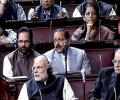
It is not in the Lok Sabha, where the BJP has a clear majority, but the Rajya Sabha that the Opposition has ganged up to checkmate Prime Minister Narendra Modi's ambitious plans.
